MCIT offers no-cost consultation to members for both risk management and loss control. MCIT consultants are dedicated to assisting members with ways to reduce their risk exposures, mitigate risks and prevent claims across their operations.
Risk Management Consultation: Individualized Support for Members’ Risk Management Efforts
MCIT provides risk management consultation services to its members. MCIT consultants respond to coverage, liability and risk management concerns. Risk management consultation services include:
- Review of contracts from a risk management perspective
- Coverage discussions and explanation
- Advice about how members can best manage risks
- Training about specific topics


Risk management consultants also conduct in-person training for new MCIT primary contacts at member organizations. This session reviews:
- Information about MCIT
- Benefits of managing risks
- Resources to help members with risk management and safety
- Whom to contact at MCIT for various needs
- Key forms to complete: property, liability and workers’ compensation
- Important dates to remember (e.g., contribution renewal, requests for payroll information, etc.)
- Training opportunities
- The importance of maintaining property schedules and how to do so
- Types of property and best coverage options for them
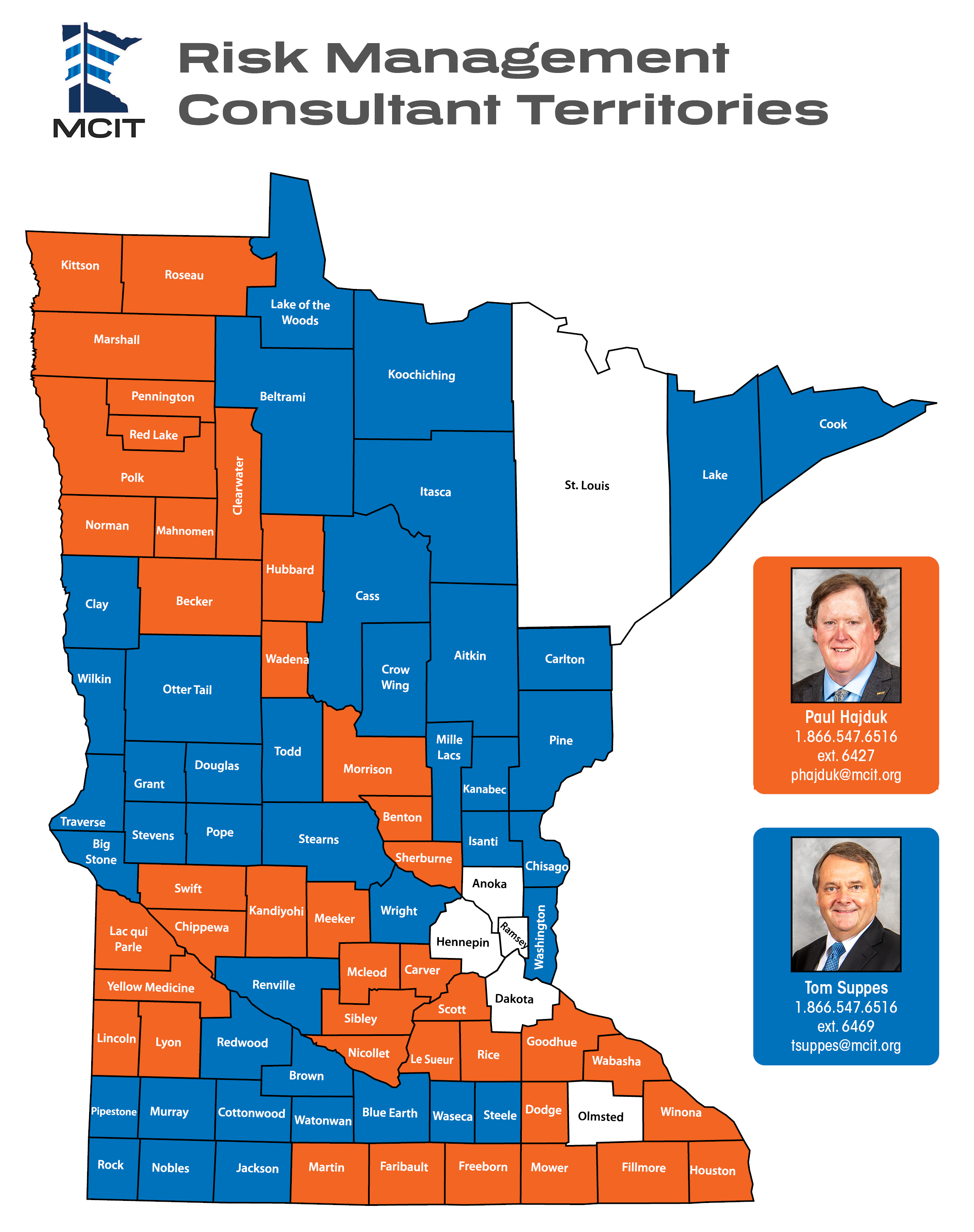
MCIT risk management consultants are ready to answer members’ questions regarding a specific circumstance or a general inquiry about coverage. Members are encouraged to contact their risk management consultant.
Paul Hajduk, MCIT risk management consultant
- Serves members located in the orange counties shown on map
- Phone ext. 6427
Tom Suppes, MCIT risk management consultant
- Serves members located in the blue counties shown on map
- Phone ext. 6469
Loss Control Consultation: Individualized Services to Strengthen Members’ Workplace Safety Efforts
Each MCIT member has an assigned MCIT loss control consultant who provides customized loss control and safety consultation.
MCIT loss control consultants help members with:
- Written safety programs
- Hazard identification, such as workplace safety surveys and reports
- Ergonomic assistance
- OSHA standards interpretation
- Employee injury data analysis
Loss control consultants also can:
- Participate in safety committee meetings
- Conduct employee safety training (see tab below)
- Provide written loss prevention educational resources


Have a Question or Concern for an MCIT Loss Control Consultant?
MCIT loss control consultants are ready to answer members’ questions regarding a specific circumstance or a general safety inquiry. Members are encouraged to connect with their loss control consultant.
Nick Lindberg, MCIT loss control consultant
- Serves members located in the northern half of Minnesota
- Phone ext. 6468
Alethea Sheridan, MCIT loss control consultant
- Serves members located in the southern half of Minnesota
- Phone ext. 6429

Remote Training Options
MCIT loss control consultants can provide tailored virtual safety and loss prevention training to members.
Using MCIT’s video conference platform or the member’s system, consultants can deliver training to a targeted audience. To participate, attendees simply need an Internet-connected device with speakers or headphones (e.g., computer, tablet or smart phone).
Schedule a Session
See list of topics below. Members should contact their assigned MCIT loss control consultant to schedule a virtual training session.
Job hazard analyses are an important loss control tool used to identify the potential hazards of job tasks. This knowledge can help identify loss prevention controls, such as proper personal protective equipment, and used as training for new employees. This training discusses the benefits of using job hazard analyses and how to create them.
Focuses on awareness and prevention techniques for employees to protect against cyber-attacks. Topics include social engineering, password protection and safe Internet browsing practices.
Spotlights awareness of visual, cognitive and manual distractions; and techniques to help prevent driving while distracted.
Targeted to employees who make home visits, this training focuses on recognizing potential dog activity, signs of aggression and best practice techniques to help prevent against dog bites.
Focuses on maintaining neutral and supportive postures when using a computer or other equipment at the desk. Key concepts include chair adjustments, positioning equipment for comfort and ergonomic best practices when using the computer or working at the desk. The importance of stretching throughout the day is also addressed with demonstration of easy stretches that can be done at the workstation.
Provides an explanation of ergonomic risk factors and associated injuries for work tasks conducted away from a desk. The discussion focuses on positions and postures, force and vibration, task repetition and the environmental elements employees deal with at work and after hours.
Trainees have the opportunity to look through the eyes of a loss control consultant and become attuned to identifying hazards that could cause injury to themselves or other co-workers. Emphasis is placed on the three R’s: recognizing, remedying and reporting. This training can be tailored to general or specialized work areas.
Discussion centers around ear structure, causes of hearing loss, proper use of ear protection and best practice techniques to reduce the risk of hearing loss. Note: This is not a hearing conservation program training.
Targeted to supervisors and others responsible for conducting incident investigations, the training discusses the importance of these investigations in reducing future injury and loss, techniques for thorough investigations and root cause analysis.
Discusses hazards encountered when working outside during the summer or winter, such as heat stress or cold stress; noxious plants and ticks; slip, trip and fall hazards. Employees learn prevention strategies for common outdoor hazards.
Instructs employees on the safe use of chemical products at work and at home. Provides an explanation of product labels, safety data sheets, personal protective equipment and proper storage, and use of common products. Note: this training does not fulfill OSHA Employee Right to Know requirements and is meant to be used as supplemental training.
Teaches employees about safe ladder use best practices, including safe use of step and extension ladders.
Identifies common hazards that may lead to slip, trip and fall injuries. Prevention best practices are discussed. This training can be tailored to seasonal risks, as well as specific work setting.
Instructs employees about the importance of stretching throughout the workday. This training includes simple stretching exercises employees can do at their desks or most anywhere else. Proper lifting techniques are also discussed.
Explains current Minnesota Occupational Safety and Health Administration inspection procedures, lists items all members should have readily available during an inspection and provides helpful tips for the walkthrough.
Members in need of staff training on other topics are encouraged to contact their assigned MCIT loss control consultant to discuss the potential for a custom session. Reach consultants at 1.866.547.6516.
Minnesota OSHA Offers Free Workplace Safety Consultation
Minnesota OSHA Workplace Safety Consultation provides free voluntary and confidential workplace safety and health assistance to Minnesota employers. Services include on-site consultation, training, education and outreach. Services are provided by safety and health experts who are highly qualified occupational safety and health professionals.
The Workplace Safety Consultation program is completely separate from MNOSHA Compliance, and no citations or fines are issued, provided employers agree to correct all serious hazards identified by Workplace Safety Consultation.
Contact MNOSHA Workplace Safety Consultation
- 651.284.5060 or 1.800.657.3776
- osha.consultation@state.mn.us
- DLI.mn.gov